REPUBLISHED FROM JUNE 27
Readers have been pleased with many articles in 2024 at The Copenhagen Post.
Throughout the holidays we re-publish the most popular stories of the past year. Hope you will enjoy!
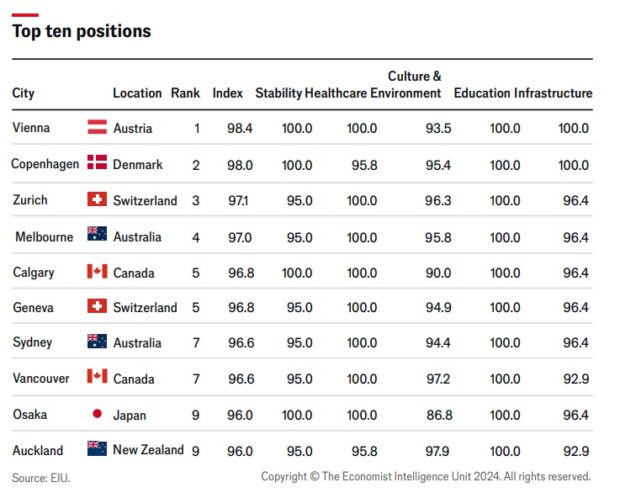
Copenhagen has retained second place on this year’s list of the world’s most liveable cities, published today by the Economist Intelligence Unit (EIU) – a sister organisation of The Economist.
The Austrian capital Vienna took first place for the third year in a row.
173 cities across the globe were scored from 1 to 100, “where 1 is considered intolerable and 100 is considered ideal”, on factors that significantly influence quality of life across Healthcare, Culture & Environment, Stability, Infrastructure and Education.
This year, Denmark received a score of 100 in three out of five categories, missing out on top marks for Culture & Environment and Healthcare.
Gertrud Jørgensen, a professor of urban planning at the University of Copenhagen, tells TV2 Kosmopol that, despite losing points in the Healthcare category, the Danish capital is attractive because of its welfare state.
“In general, Denmark is a good country to live in because it is a rich country. It’s also a welfare society in which it is easy to look after our children,” she explains.
She notes also the “fantastic cycle path network” and “good public urban spaces”, and says that, at the University of Copenhagen, she meets many international students who give the impression that they like living in Denmark.
“They want to stay here. It has not so much to do with the city itself, but the fact that it is a welfare society,” she said.
Western Europe and North America fare well
Western Europe remains the best-performing region for liveability, coming top in four categories, while second-placed North America is best for education.
The 30 western European cities in this year’s ranking reported an impressive average score of 92 out of 100. However, the region’s overall score has slipped since last year, owing to a deterioration in the stability category, amid increasing instances of disruptive protests – such as in Germany, Ireland and Belgium – and crime.
North America scores an average of 90.5 for its 25 cities, but infrastructure scores have fallen since last year in Canada, owing to an ongoing housing crisis, writes EIU in the report.
Housing struggles in Canada and Australia
In fourth place, Melbourne is one of the four Asia-Pacific cities in the top ten, which also includes two Canadian cities – Calgary and Vancouver.
Although still towards the top of the ranking, both of the leading Australian cities, Sydney and Melbourne, have slipped down amid a significant shortfall in housing availability.
For similar reasons, Toronto in Canada has dropped out of the top ten into 12th position after two years.
Hong Kong up, Tel Aviv down
The biggest improvement since last year is in the island city of Hong Kong, which has leapt in the rankings from 61st to 50th, following improvements in its Stability and Healthcare scores.
Other Asian cities, including Singapore, Ho Chi Minh City and Bangalore, also saw their healthcare or education indicators improve this year, pushing them up the rankings.
The Israeli city of Tel Aviv saw the biggest fall from 92nd to 112th as its scores for Stability, Culture & Environment, and Infrastructure deteriorated due to damage inflicted by the Hamas attack on Israel in October 2023, and the subsequent war against Hamas in Gaza.
Israel is under pressure to declare a ceasefire in Gaza, but is likely to continue its campaign there in some form during 2024, writes EIU.
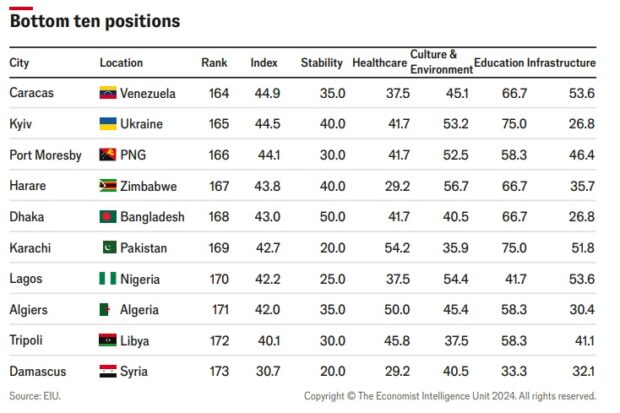
At the bottom of the index is the Syrian city of Damascus.