The Danish healthcare system faces the same challenges as seen in most places in Europe.
The population is getting older and more demanding of treatment. The years are getting smaller, and it is not a given that you will work with health.
The population’s expectations for care and treatments are high.
It is a difficult challenge to solve. A few years ago, Prime Minister Mette Frederiksen set up a so-called “Robustness Commission” with corona chief Søren Brostrøm. On Monday, he submitted the commission’s recommendations, although he no longer works in Denmark, but for the WHO in Switzerland.
“The big challenge is well known. It is demography. The proportion of elderly people will increase quite significantly over the next 50 years. It is “a burning platform” that younger generations does not become correspondingly larger,” says Søren Brostrøm at a press conference.
His message to the citizens of Denmark is quite unsentimental. Nor does Brostrøm have the burden of having to please the masses as a politician:
“Something new and something quite drastic must happen in a large number of areas. The changes are necessary. Many will experience some of the changes as service deterioration,” says Brostrøm.
Offers must be differentiated
So what is the commission of 16 health professionals proposing?
There are six premises which result in a series of recommendations. The premises have been rolled out in Jyllands-Posten
In the future, healthcare and elderly care must not use more resources than now. Every 10th of the workforce is employed within health and care. It is not sustainable to increase that share if there is to be labor for other sectors – Furthermore, employees are extremely difficult to get hold of.
There must be a sharper prioritization of tasks. You must move away from the very rights-based management of the sequence and scope of a treatment. Less power for patient rights and the place on the waiting list. At the same time, the offers to citizens and patients must be differentiated. Not everyone should have the same offer.
Hospitals with expensive services must not grow any more. On the contrary. It is in care for the elderly that more services must be offered – precisely to avoid hospitalizations and more invasive treatments.
Working environment must be improved and shifts must be shared collectively. Prevention must be strengthened. The Danes’ high consumption of smoke, alcohol and sugar in food is a major challenge, which is exacerbated by too little physical activity.
Avoid health deserts
Finally, there is a social and geographical inequality in health. Many elderly and sick people live on the outskirts of Denmark, where there are few people to help them. Both now and in the future.
Brostrøm points to countries such as England and the USA, where he sees “health deserts”, where the weakest live without the prospect of getting help.
Among the 20 recommendations that follow these premises are:
More people must take extra shifts, more people must work full time, nurses have to take over medical tasks, and more unskilled people have to be brought in in an attempt to retain staff.
The commission suggests that not all sick and elderly people should have the same offer. For example, in a cancer course there must be citizens who, as an alternative to a check-up visit to a hospital, will have to cope with digital solutions from home.
“Our focus has been on robustness and making recommendations to solve challenges. Not only in the short term, but also with the high beam on,” Brostrøm says.
Greater use of skills from internationals
One recommedation is that skills from abroad must be used better through strengthened affiliation.
The Commission assesses that there is potential associated with looking more broadly at the recruitment basis of people from EU/EEA countries who are motivated to take a health education and work in Denmark.
Denmark is below the OECD average for the proportion of doctors and nurses who are educated abroad, and the attachment of foreign employees is not strong enough. Around 20 per cent of international doctors and nurses who were authorized from 2016-2021, had left the country again after five years.
The Commission believes that there is a need for a broader focus on competences from abroad, including removing any barriers to mobility and attachment. There must be a particular focus on ensuring a strengthened attachment of internationals who already live Denmark.
Big things to do in reality
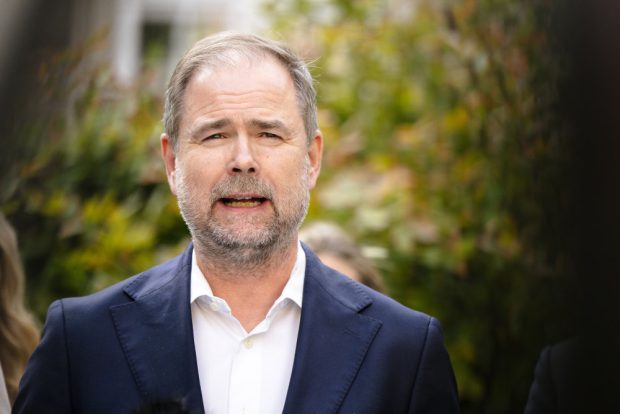
Minister of the Interior and Health Sophie Løhde is now tasked with looking at the recommendations. Time will tell if they are followed.
“On paper, these may be small, well-known measures, but they are big things to do in reality,” says Løhde, who agrees with the recommendations, which “are about dividing the work between several people in the healthcare system”.